A Realistic Budget for a Single Adult Living in the United States
What does it really cost to live alone in the US? A realistic monthly budget for a single adult, with an illustrative breakdown, take-home pay math and city differences.
Low risk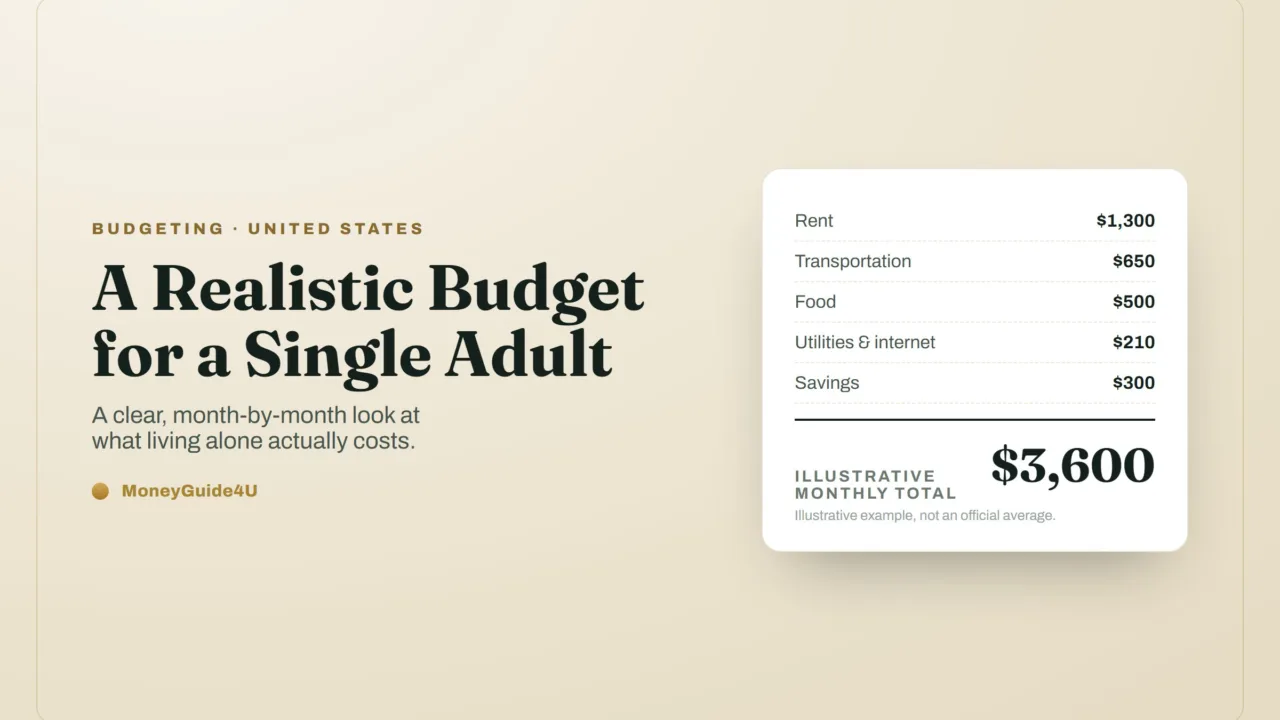
A Realistic Budget for a Single Adult Living in the United States
Living alone changes the math of a budget. There is no second income to soften a rent increase, no one to split the internet bill, and no one to cover the lease if you lose a paycheck for a month. A budget for one adult is not simply a family budget cut in half — it is shaped by a different set of pressures, and rent sits at the center of almost all of them.
Most budget advice starts with percentages. Percentages are useful, but they hide the part that matters most: for someone living alone, housing is usually the single largest and least flexible line. A realistic budget starts with that fixed cost and builds around it, rather than starting with a number someone else used.
What Does It Cost for One Adult to Live in the US?
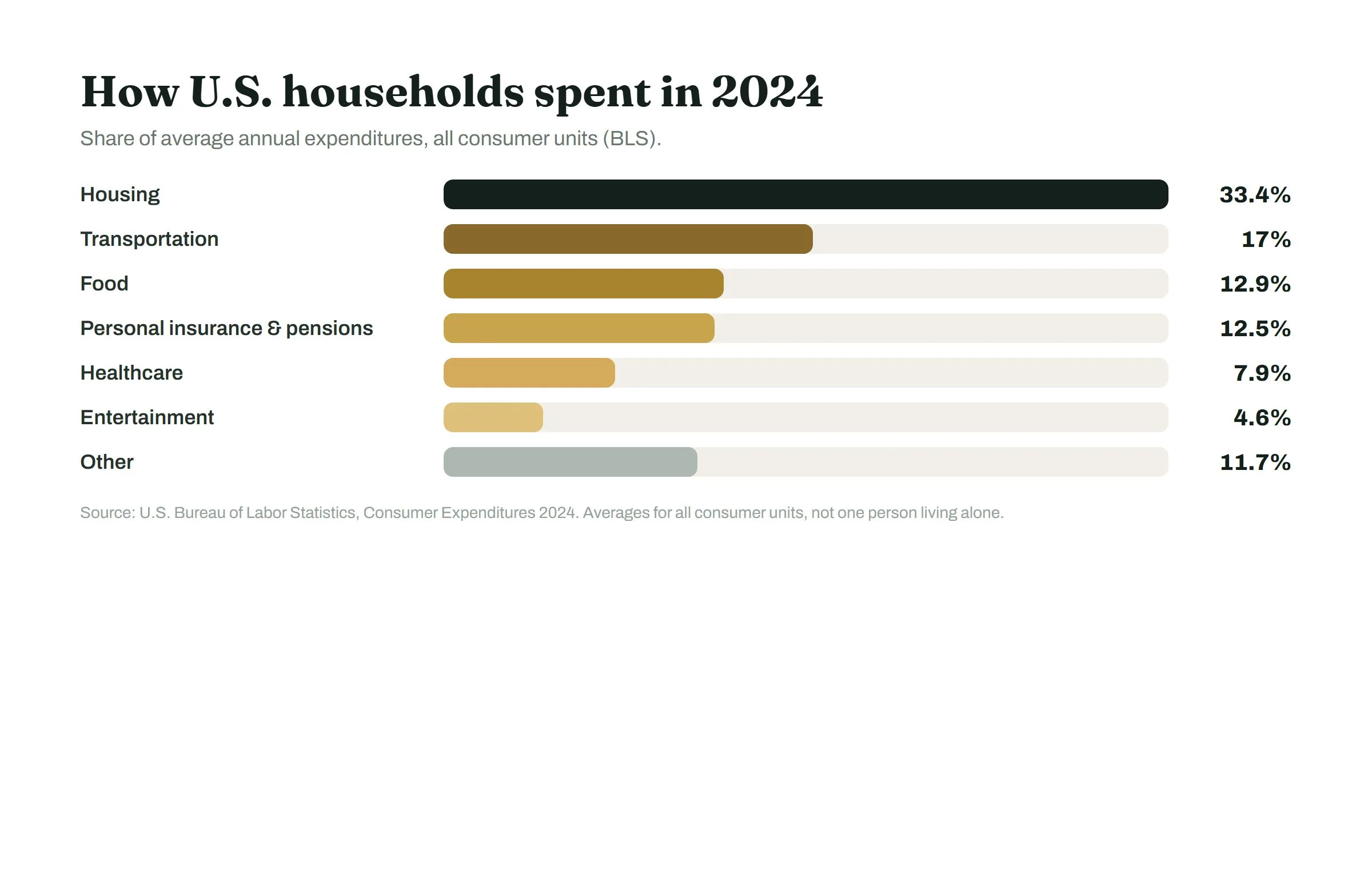
The closest official benchmark comes from the U.S. Bureau of Labor Statistics. In its Consumer Expenditures 2024 survey, the average household spent $78,535 a year — about $6,545 a month. Housing alone accounted for 33.4% of that, and transportation added 17.0%. Together, those two categories were just over half of all spending.
Those figures are a national average across every kind of household, from a single renter to a family of five. They are not the budget of one person living alone. A single adult often spends less in total — fewer people means less food and lower healthcare use — yet the biggest fixed cost, rent, does not shrink just because only one person lives there. That mismatch is why a one-person budget can feel tighter than the national averages imply.
A Realistic Monthly Budget Breakdown
Below is what each major category usually covers, and how it behaves when only one person is paying the bill.
Rent and housing
Rent is the anchor of the whole budget. A one-bedroom apartment often runs somewhere between about $1,200 and $2,000 a month in larger metros, and roughly $800 to $1,100 in smaller cities. Add renter’s insurance, usually $15 to $30 a month. A common guideline is to keep housing near 30% of take-home pay, but in expensive cities that is easier to aim for than to hit. If you are weighing a purchase against renting, our guide to how much house you can afford uses the same logic.
Electricity, water, and internet
Utilities move with climate and the age of the building. Plan for roughly $120 to $200 a month for electricity, water and gas, and $50 to $80 for internet. Living alone means you carry the full fixed charges — there is no one to split the base fee — so these relatively small lines still matter.
Groceries and dining out
Groceries for one person typically land between $250 and $450 a month, depending on how much you cook and where you shop. Dining out, takeout and coffee can add another $100 to $250 without much notice. Cooking at home is the single easiest lever in a one-person budget, because restaurant meals scale down poorly when you are feeding only yourself.
Transportation and car expenses
A car is often the second-largest cost after rent. Budget roughly $250 to $500 for a payment, $100 to $180 for insurance and $80 to $150 for fuel. If you can rely on transit, walking or a bike, this line drops sharply — and a car-free month is one of the few places a single adult can free up several hundred dollars at once.
Health insurance and medical expenses
Health costs depend heavily on whether an employer subsidizes your plan. Through work, premiums may be modest; on the individual market, a plan can run several hundred dollars a month or more. Set aside a small amount for copays and prescriptions so a single doctor visit does not derail the month.
Phone and subscriptions
A phone plan usually costs $40 to $80 a month, and streaming or software subscriptions another $30 to $70. These lines are small individually and surprisingly large together, which is why they are the first place to look when you need to trim.
Personal care, clothing, and entertainment
Personal care and haircuts run about $30 to $80; clothing about $40 to $100; and entertainment or hobbies about $80 to $200. None of these is optional for a life that feels sustainable, but each is flexible month to month.
Savings and emergency fund contributions
Savings should be a bill you pay yourself, not whatever is left over. Even $200 to $400 a month builds a real cushion. Aim to reach a few months of essential expenses in an emergency fund before investing aggressively; our guide to building an emergency fund explains how to size it.
Example Monthly Budget for a Single Adult
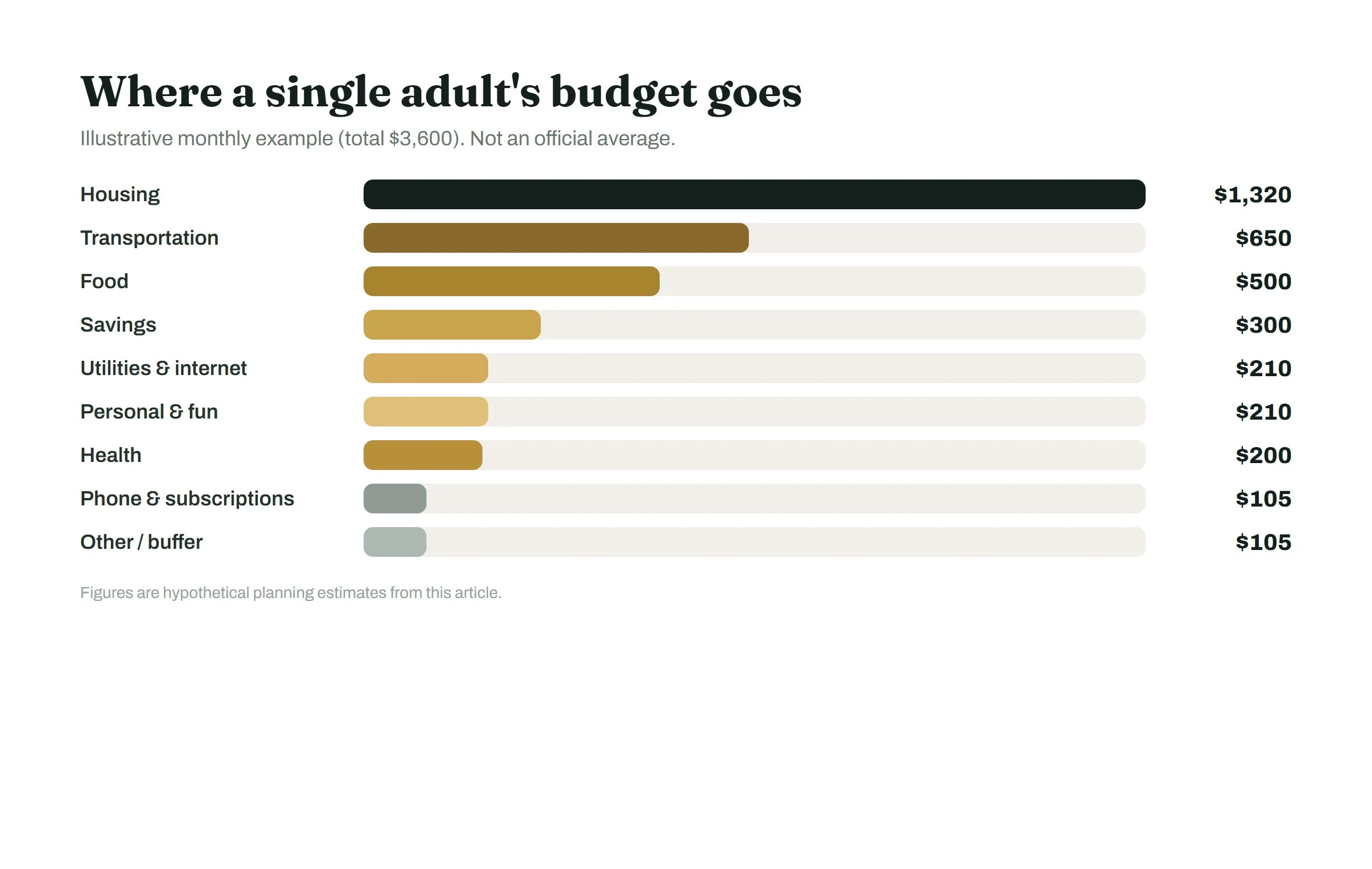
Here is an illustrative monthly budget for one adult in a mid-cost U.S. city. It is a planning example, not an official national average.
| Category | Monthly |
|---|---|
| Rent | $1,300 |
| Renter’s insurance | $20 |
| Utilities (electric, water, gas) | $150 |
| Internet | $60 |
| Groceries | $350 |
| Dining out & coffee | $150 |
| Car payment | $400 |
| Auto insurance | $130 |
| Fuel | $120 |
| Health insurance premium | $200 |
| Phone | $60 |
| Streaming & subscriptions | $45 |
| Personal care & clothing | $90 |
| Entertainment & hobbies | $120 |
| Savings & emergency fund | $300 |
| Miscellaneous / buffer | $105 |
| Total | $3,600 |
The total is the part to treat with care. Change only the rent — say, $900 in a smaller city versus $2,000 in a coastal metro — and the same budget swings by more than a thousand dollars a month. That is why any single “correct” monthly number should be read as a starting point, not a target.
How Much Take-Home Pay Do You Need?
Budgets are built on take-home pay, not your salary. Gross pay is what you earn before deductions; take-home pay is what actually lands in your account after federal income tax, FICA (Social Security and Medicare) and state tax. Depending on your income, filing status and state, those deductions can remove roughly 15% to 30% of a paycheck. Understanding that gap early keeps a budget from being built on money you never see — a core idea in our beginner’s guide to personal finance.
From gross pay to a workable budget
Suppose your gross pay is $4,600 a month. If roughly 20% goes to taxes and deductions, your take-home is about $3,680.
| Gross monthly pay (example) | $4,600 |
|---|---|
| Estimated taxes and deductions | about 20% |
| Approximate take-home pay | $3,680 |
Why it matters
That leaves a thin margin above the $3,600 illustrative budget. In a lower-cost city the same income would feel comfortable; in a high-cost metro it might not. The point is to plan from take-home pay, then test it against your real city.
Because the example budget is illustrative, the income you need is not a fixed number. A single adult might need take-home pay near $3,500 to $4,000 a month in a low-cost area and $5,000 or more in an expensive metro. Treat any single figure as a starting point to test against your own rent and expenses.
How Living Costs Differ by City
Cost of living varies enormously across the United States — and housing drives most of it. Rent in a high-cost metro can run two to three times the rent in a smaller city, while groceries and fuel differ far less from place to place. The practical consequence is simple: a budget that works in one city may need a housing line 30% to 50% larger in another. Before you choose a number, look up the rent for the kind of apartment you would genuinely rent, not the average for the whole metro.
Practical Ways to Reduce Monthly Expenses
- Shop your rent at renewal — moving within the same city can reset a price that keeps climbing.
- Consider a roommate or shared housing if saving faster is the goal.
- Cook most meals at home and plan grocery trips around what you will actually eat.
- Compare auto insurance at every renewal; rates for the same coverage vary widely.
- Audit subscriptions and cancel anything you have not used in a month.
- Switch to a lower-cost phone plan; many people overpay for data they never use.
- Automate a transfer to savings on payday so it happens before spending.
Common Budgeting Mistakes to Avoid
- Building the budget on gross income instead of take-home pay.
- Committing to rent before adding utilities and transportation to the picture.
- Treating savings as whatever is left at the end of the month.
- Copying averages that do not match your city or your habits.
- Forgetting irregular costs such as car registration, annual fees and holidays.
- Leaving no buffer, so one surprise turns into credit-card debt.
Frequently Asked Questions
Frequently asked questions
How much should a single person budget per month?
There is no universal figure. The illustrative example here totals about $3,600 a month for a mid-cost city, but rent and location drive most of the difference. Start with your actual rent, then add utilities, food and transportation.
What percentage of income should go to rent?
Many guidelines suggest keeping housing near 30% of take-home pay, though high-cost cities make that difficult. The lower your rent relative to income, the more room you have for savings and emergencies.
How much should I save each month?
Even $200 to $400 a month builds meaningful savings. Priority one is usually an emergency fund covering several months of essential expenses before you invest more aggressively.
Is it cheaper to live alone or with a roommate?
Living alone costs more per person for rent, utilities and internet. A roommate can cut the housing line substantially, which is often the fastest way to free up money for savings.
What is the average cost of living in the US for one person?
The BLS reported average annual expenditures of $78,535 for all consumer units in 2024, but that covers households, not one person living alone. A single adult often spends less in total, though rent can weigh more heavily on one income.
Build a Budget That Fits Your Actual Life
A realistic budget for a single adult is not a number copied from an article — it is a plan built from your own rent, your own city and your own priorities. Use the national averages as a reference, use the illustrative total as a starting sketch, then replace every line with a figure you can verify. A budget you can actually follow beats a perfect one you abandon in three weeks.
Start with the fixed costs, protect your savings first, and treat anything uncertain as a range rather than a rule. Do that, and living alone becomes less about squeezing every dollar and more about knowing where your money is going.
Sources
Disclaimer
This article is general educational information, not personalized financial advice. Dollar amounts are illustrative planning estimates and are not official statistics; only the cited BLS figures are official. Living costs differ by location and change over time, so verify current local prices before making decisions.
Related articles

Personal Finance for Beginners: How to Get Your Money Under Control
A practical, jargon-free personal finance guide for beginners: track your spending, build an emergency fund, manage debt and understand saving versus investing.


Building an emergency fund in six months
A staged approach to building a cash buffer, and how much is actually enough.

Roth IRA vs. Traditional IRA: Which Differences Matter Most?
Roth or traditional IRA? Compare 2026 contribution limits, income limits, tax treatment and withdrawal rules — and see which account fits your plan.