Understanding what moves your credit score
The five factors that influence a credit score, and which ones you can actually control.
Medium risk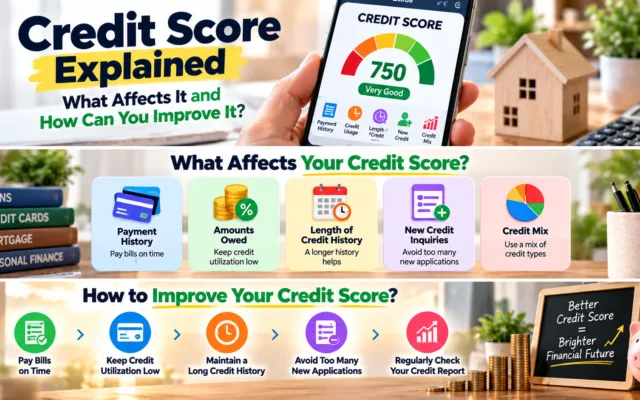
Your credit score is a number that lenders use to estimate how likely you are to repay borrowed money. It is not a measure of your income, your savings or your worth as a person. It is a summary of information in your credit reports, calculated by a scoring model.
The details matter because a score can affect whether you are approved for a credit card, car loan or mortgage, and how much that borrowing costs. Landlords, insurers and utility companies may also use credit information. Understanding the main factors can help you spot errors and make more informed decisions.
What a credit score is
A credit score is a prediction of credit behaviour based on information in your credit reports. The Consumer Financial Protection Bureau (CFPB) explains that companies use scores to make decisions about mortgages, credit cards, auto loans and other products, and to set interest rates and credit limits.
Most credit scores range from 300 to 850, but the number is not universal. You have more than one score because different credit reporting companies, scoring models, loan types and calculation dates can produce different results. A score you see in a banking app may be an educational score rather than the exact score a particular lender will use.
Why your score matters
A higher score generally makes it easier to qualify for credit and may lead to better terms. A lower score can mean higher interest rates, smaller credit limits or a declined application. The Federal Trade Commission (FTC) notes that scores can also affect insurance and housing decisions in some cases.
A score is only one part of an application. Lenders may also consider income, existing debts, employment history, cash reserves and the specific loan. A good score does not guarantee approval, and a lower score does not automatically mean rejection.
The five main factors
Scoring models differ, but most look at the same broad categories. The table below is a general guide, not a set of fixed percentages. The weight given to each factor varies by model and by the person’s credit profile.
| Factor | What it reflects | Can it change quickly? |
|---|---|---|
| Payment history | Whether you paid bills on time | Slowly |
| Amounts owed | Balances and credit utilisation | Often, but reporting takes time |
| Length of credit history | How long you have managed credit | No |
| New credit and inquiries | Recent applications and new accounts | Partly |
| Credit mix | Experience with different credit types | Slowly |
1. Payment history
Late payments, missed payments, accounts sent to collection and bankruptcy can all affect a score. On-time payments over time are generally positive. Payment history is often one of the most important categories, but no single factor tells the whole story.
2. Amounts owed and credit utilisation
This category looks at how much you owe and how much of your available credit you are using. Using a large share of a credit limit can be a warning sign to some scoring models. Paying down balances can help, but it may take time for the change to appear in your reports.
3. Length of credit history
A longer record of managing credit can help, especially when payments are on time. A short history is not a permanent problem. Responsible use over time can build a longer record.
4. New credit and inquiries
Applying for several new accounts in a short period can affect a score. Not every inquiry counts the same way. The FTC notes that some rate shopping for a mortgage or auto loan may be treated as a single inquiry under some scoring systems, and certain account-monitoring or prescreened inquiries are not counted against you.
5. Credit mix
Some models consider whether you have experience with different types of credit, such as a credit card, auto loan or mortgage. A mix is not a reason to borrow money you do not need. The goal is responsible use, not a collection of accounts.
Why you have more than one score
Credit scoring is not a single national number. Each nationwide credit bureau may hold slightly different information, and each scoring model may weigh that information differently. Mortgage, auto and credit card lenders may also use different score versions.
Some free scores are educational scores designed to give you a useful indication rather than an exact lender decision. The myFICO education pages explain how FICO scores are built and why versions differ. The exact score a lender sees can depend on the bureau, model, date and product.
How to check your reports and scores
Start with your credit reports. The three nationwide credit bureaus – Equifax, Experian and TransUnion – collect credit information. You can request free reports from each bureau at AnnualCreditReport.com. The FTC free credit reports guide explains that AnnualCreditReport.com is the only website authorised by law to provide the free annual reports, and that weekly reports have been available from each bureau.
Review each report for errors, such as accounts you do not recognise, incorrect balances or payments reported late when you paid on time. If you find a mistake, dispute it with the credit bureau and the business that supplied the information. Checking your own report is not the same as applying for credit and is not a hard inquiry.
You may also get a score free from a bank, card issuer or credit union. Find out whether it is a FICO score, a VantageScore or an educational score, and which bureau supplied the data. A score without that context is harder to interpret.
Practical steps to improve your credit profile
- Pay at least the minimum on every account by the due date. Set reminders or automatic payments if that helps you avoid a late payment.
- Reduce high balances where your budget allows, especially on cards that are close to their limits.
- Avoid applying for several new credit accounts in a short period unless you genuinely need them.
- Check your reports before a major application so you have time to correct errors.
- Keep older accounts open when they have no fee and you are not tempted to overspend; closing them can shorten your history and reduce available credit.
- Use credit regularly only if you can repay it. A card you do not need does not improve a score by itself.
For a fuller explanation of how scores are calculated and how to improve them, see our credit score guide. If you are preparing to apply for a loan or card, our guide to how lenders decide loan eligibility explains the checks involved.
Common mistakes
- Assuming there is only one score and that every lender sees the same number.
- Paying for a score without checking whether a free score is already available from a bank or card issuer.
- Disputing accurate information instead of focusing on the underlying account.
- Closing accounts shortly before a mortgage application without checking the effect on utilisation and history.
- Co-signing for someone else without understanding that the account can affect your own credit.
- Expecting a large score increase immediately; credit reporting and scoring changes usually take time.
No company can guarantee a specific score increase. Consistent payment behaviour, lower balances and accurate reports are the practical foundations.
Frequently asked questions
What is a good credit score?
There is no universal cutoff. Lenders set their own criteria, and the score that matters depends on the lender, the product and the scoring model. A higher score generally improves your chances of approval and better terms, but it does not guarantee either.
Does checking my own credit score hurt it?
Checking your own credit report or score is generally a soft inquiry and does not affect your credit history. A lender application can create a hard inquiry, which may be recorded.
Why are my scores different?
Credit bureaus may hold different information, and scoring models may weigh the same information differently. Scores can also change between reporting dates and loan types.
Can I improve my score quickly?
There is no guaranteed fast fix. Paying bills on time, reducing balances, correcting report errors and avoiding unnecessary new applications can help over time. Be cautious of anyone promising a specific increase.
Sources
- What is a credit score? Consumer Financial Protection Bureau
- Credit Scores Federal Trade Commission
- Free Credit Reports Federal Trade Commission
- Credit education: credit scores myFICO
Related articles

Credit Score 2026: 5 Key FICO Factors That Affect Your Score
Understand the five key FICO score factors in 2026, how they are weighted, and what U.S. consumers can do to protect their credit score.


Why Credit Card Debt Is Rising in 2026 — And How to Avoid the Debt Trap
Credit cards can make everyday spending easier, but interest and minimum payments can turn a manageable balance into long-term debt. Here is how to take control.

Mortgage Rates in 2026: How to Decide Whether Refinancing Is Worth It
A lower mortgage rate can look attractive, but refinancing involves more than comparing two percentages. Understand the costs before making a decision.