Federal Reserve Policy: Rates on Hold, but Caution Remains for Bonds and Inflation
The Federal Reserve held its target range at 3.75%-4.00% on October 28, 2026, with two officials preferring a hike. Inflation remains elevated, Treasury yields are above 5%, and mortgage costs are still high. Here is what the decision means for bonds, savers and household budgets.
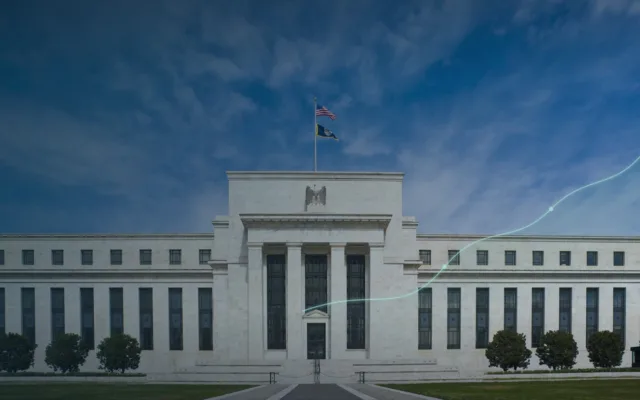
The Marriner S. Eccles Federal Reserve Board Building in Washington, D.C. Photo: Federal Reserve Board / Wikimedia Commons (public domain); illustration by MoneyGuide4U.
The Federal Reserve left its benchmark rate unchanged on October 28, 2026, but the decision was not an all-clear on inflation. The target range for the federal funds rate remains 3.75% to 4.00%, where it has been since September. Two officials wanted another quarter-point hike. For households, the question is what still-high inflation and elevated Treasury yields mean for bonds, mortgages and savings.
What Did the Federal Reserve Decide?
The Federal Open Market Committee voted 10 to 2 to keep the range at 3.75% to 4.00%. Governors Lisa D. Cook and Beth M. Hammack dissented because they preferred a 25-basis-point increase, according to the official statement. A basis point is one-hundredth of a percentage point. The statement said activity is expanding at a strong pace, domestic spending is resilient, productivity and capital investment are strong, job gains have kept pace with the workforce, and unemployment has changed little. It also said inflation remains elevated and that “the accumulation of more information” will guide the next move. The next meeting is December 8-9.
Why Is the Fed Still Cautious About Inflation?
Consumer prices rose 3.7% in the year through September 2026, while core CPI, excluding food and energy, rose 2.6%, the BLS reported. Energy rose 20.4% and gasoline 34.2%, so fuel is driving the headline. The Fed prefers PCE: in August, headline PCE was 3.4% and core PCE 3.0%, the BEA said. September PCE was due October 29. Core CPI and core PCE use different baskets, so they need not match. Both show inflation above the Fed’s 2% goal, with energy adding volatility. The two dissents signal that some officials think policy is not restrictive enough; the majority wants more evidence.
How Can Fed Policy Affect Bond Yields?
Bond yields are set by markets, not directly by the Fed. Short-term yields track policy expectations; long-term yields reflect the expected rate path, inflation expectations and a term premium, the extra compensation for holding longer bonds. On October 28, the Treasury curve showed 2-year at 4.67%, 10-year at 5.05% and 30-year at 5.37%. The 2-year above the top of the Fed’s range suggests some investors expect further tightening; the long end above 5% shows inflation and term-premium concerns remain.
When yields rise, existing bond prices fall—one reason bond funds can lose value even while paying interest. Shorter bonds carry less rate risk but more reinvestment risk; longer bonds pay more but are more sensitive.
What Does This Mean for Mortgage Rates and Borrowers?
Mortgage rates follow the 10-year Treasury, inflation, Fed expectations and lender conditions—not the policy rate one-for-one. Freddie Mac’s survey put the 30-year fixed average at 7.32% for the week ending October 22, 2026, down from 7.40% but above 6.19% a year earlier. A Fed hold does not automatically lower mortgage rates.
Borrowers should compare several quotes, annual percentage rates (APRs) and fees, and avoid a payment they cannot sustain. Fixed-rate loans protect against payment increases; adjustable-rate loans may start lower but can reset. Existing fixed-rate borrowers are unaffected; home equity line and adjustable-rate holders may be more exposed.
What Could It Mean for Savers and Investors?
Higher rates can help savers: CDs, high-yield savings, money market funds and short-term Treasuries may pay more. Taxes and inflation can still reduce the real return, so compare after-tax yields and keep emergency money liquid; our guide to how much to keep in an emergency fund explains the balance.
For bond investors, higher yields improve future income but prices can fall if yields rise further; staggering maturities and holding high-quality bonds can help. For stocks, higher rates can pressure valuations, especially for companies whose profits are expected far in the future. Banks and energy may benefit in some environments, but no sector is guaranteed. A diversified, long-term plan beats reacting to one meeting; our beginner’s guide compares index funds and individual stocks.
A Real-World Mortgage Comparison
Consider a $300,000, 30-year fixed mortgage. The table isolates a half-point difference in rate. It is illustrative, not a current quote; actual rates depend on the lender, credit, down payment, points and loan type. Freddie Mac’s national average was 7.32% for the week ending October 22, 2026.
Illustrative only: $300,000 loan, 360 monthly payments, principal and interest only. Taxes, insurance, PMI, HOA fees and closing costs are excluded.
Measure
6.00% rate
6.50% rate
Difference
Monthly principal and interest
$1,799
$1,896
About $97
Total payments over 30 years
$647,515
$682,633
About $35,100
Total interest
$347,515
$382,633
About $35,100
The half-point difference adds about $97 a month and $35,100 over the full term. That is why small rate changes matter. Our guide to how much house you can afford on a $75,000 salary shows how lenders and household costs interact.
What Should Readers Watch Next?
The next FOMC meeting is December 8-9, 2026. Key data: October employment on November 6, October CPI on November 10 and October PCE on November 25. Watch energy prices, core services inflation and the labor market. After the decision, CNBC reported that CME FedWatch showed roughly an 85% probability of a 25-basis-point hike by December. That is a market expectation, not official guidance. If oil cools and core inflation eases, pressure may fade; if energy stays high, another hike becomes more likely. Our oil-and-inflation guide explains the link.
The Bottom Line
The Fed’s move is a pause, not an all-clear. Inflation is above target, energy is volatile and long-term yields are above 5%. Borrowers may face higher rates for longer; savers can find better yields; bond investors still face price risk. Control your budget, emergency fund, borrowing costs and diversification rather than trying to predict the next meeting.
Important Disclaimer
This article is for general education only, not financial, investment, tax or legal advice. It does not recommend any security, loan or savings product. Mortgage figures are illustrative and exclude taxes, insurance, private mortgage insurance (PMI), HOA fees and closing costs. Actual rates depend on the lender, credit profile, down payment, points, loan type and market conditions. Consult a qualified professional before making financial decisions.
Learn how rising crude oil prices affect inflation, fuel costs, interest rates, businesses and household budgets, with practical ways to manage the impact.